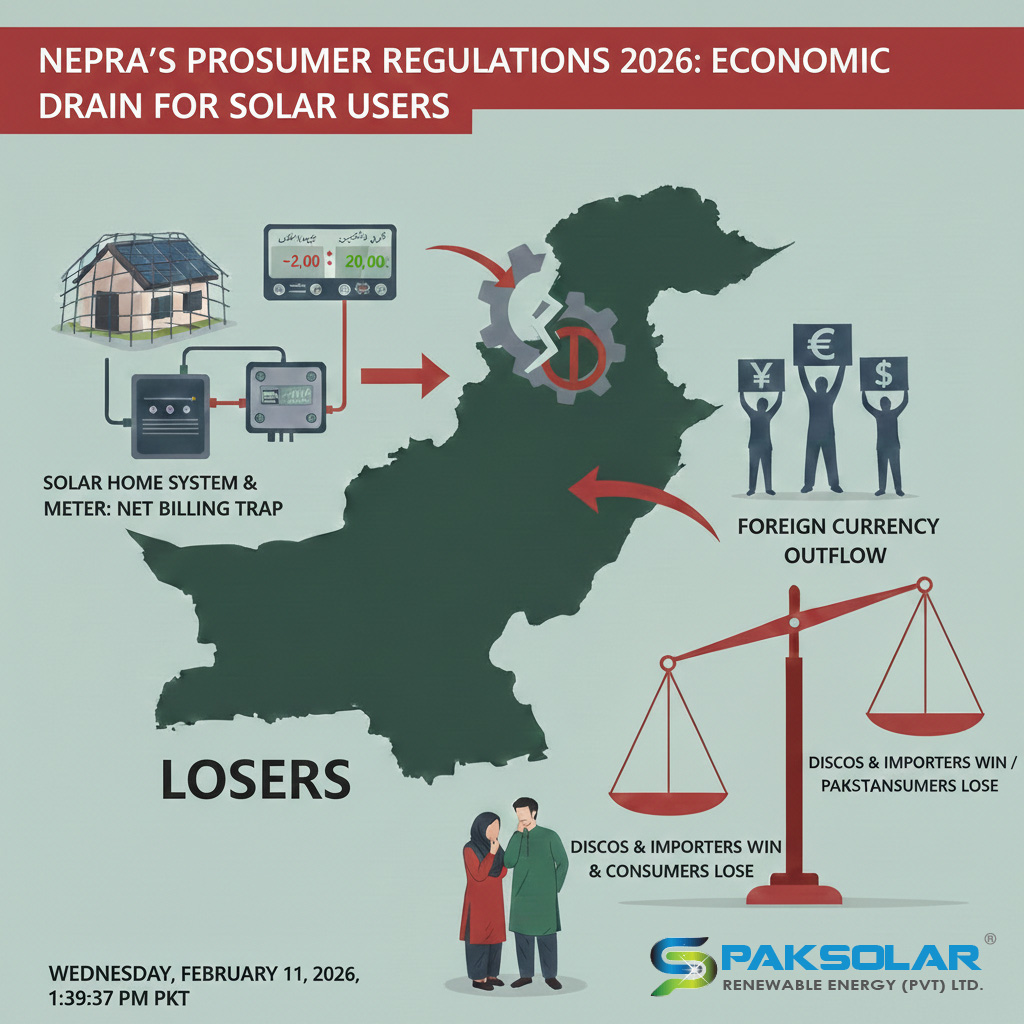
NEPRA's New Prosumer Regulations 2026: A Setback for Solar Users and Pakistan's Economy
Published: February 11, 2026 | Reading Time: 12 minutes
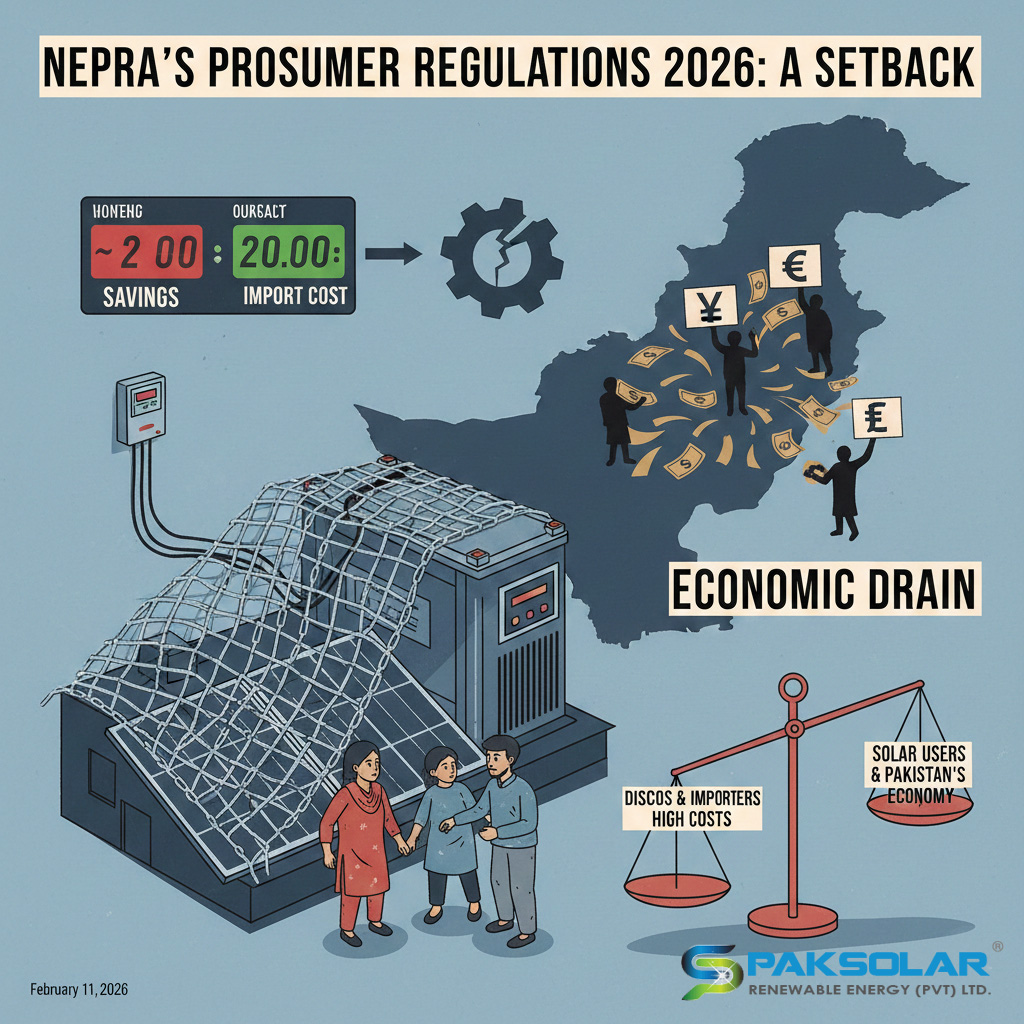
The National Electric Power Regulatory Authority (NEPRA) has issued new Prosumer Regulations 2026, replacing the previous Net Metering framework from 2015. While presented as a regulatory update, these changes fundamentally alter the economics of residential and commercial solar power in Pakistan—and not for the better.
What Changed? The Death of Fair Net Metering
Under the old system, solar users enjoyed true net metering benefits. When your solar panels generated more electricity than you consumed, you sold those excess units back to distribution companies (DISCOs) at approximately Rs. 19 per unit. Meanwhile, you purchased electricity from the grid at rates ranging from Rs. 44 to Rs. 60 per unit, depending on your consumption slab.
The new regulations have introduced "net billing" instead of net metering. Here's the crushing reality:
- What you sell to DISCOs: National average energy purchase price (significantly lower than before)
- What you buy from DISCOs: Full retail tariff (Rs. 44-60+ per unit)
- Your solar panels' capacity: Cannot exceed your sanctioned load
- New fees: Rs. 1,000 per kilowatt one-time fee for concurrence
The financial equation has been completely upended. Previously, solar users could offset their electricity bills meaningfully. Now, the economic benefit has been slashed dramatically.
The Battery Trap: From Bad to Worse
Faced with this unfavorable arrangement, solar users have only one practical option: install battery storage systems to maximize self-consumption and minimize dependence on the grid.
But here's where the economic disaster begins:
Pakistan does not manufacture lithium-ion or advanced battery storage systems domestically. Every battery, inverter, and storage component must be imported—primarily from China, South Korea, or the United States.
Consider the economic impact:
- A typical 10kW home solar system now requires 15-20 kWh of battery storage
- Quality battery systems cost Rs. 900,000 - 2,400,000 PKR
- With millions of consumers forced toward battery solutions, we're talking about billions of dollars in foreign exchange outflow
- This drains Pakistan's already fragile dollar reserves
- Increases our import bill substantially
- Worsens our trade deficit
- Puts additional pressure on the Pakistani Rupee
The cruel irony:
NEPRA's regulations, supposedly designed to manage the power sector, are inadvertently creating a massive economic drain on the country.
Who Benefits? Certainly Not Pakistani Citizens or the Economy
Losers:
- ✗ Middle-class families trying to reduce electricity costs
- ✗ Small businesses struggling with high power bills
- ✗ Pakistan's foreign exchange reserves
- ✗ The Pakistani economy overall
- ✗ Environmental goals (less incentive for solar adoption)
Winners:
- ✓ DISCOs maintaining their revenue streams
- ✓ International battery manufacturers
- ✓ Importers of battery storage systems
The Hidden Costs to Pakistan's Economy
Beyond individual household impacts, these regulations create macro-economic problems:
1. Capital Flight
Billions in foreign exchange leaving Pakistan for battery imports
2. Lost Investment
Reduced solar installations mean lost opportunities in a sector that could have been a manufacturing hub
3. Employment Impact
Fewer solar installations mean fewer jobs for installers, technicians, and related trades
4. Energy Security
Continued dependence on imported fuel for power generation instead of domestic solar resources
5. Climate Commitments
Reduced solar adoption undermines Pakistan's international climate pledges
What the Regulations Actually Say
The new regulations establish a complex bureaucratic process:
- Agreement required between prosumer and licensee (Schedule-I)
- Application process with 15 working days for initial review
- Concurrence from NEPRA required within 7 working days
- Load flow study mandatory for installations above 250 kW
- 5-year agreement term with potential renewal
- Distributed generation capacity on a transformer limited to 80% of its rated capacity
The regulations also grant DISCOs significant power to disconnect prosumer facilities for maintenance, non-compliance, or fault conditions—often with minimal notice.
Public Awareness: What You Need to Know
If you're considering solar in 2026:
- Calculate carefully: The old net metering economics no longer apply
- Budget for batteries: Without storage, solar makes limited financial sense now
- Consider the payback period: Your ROI timeline just got much longer
- Understand your agreement: The 5-year contract has specific terms that favor DISCOs
- Factor in the one-time fee: Rs. 1,000 per kW adds to upfront costs
For existing net metering users:
The regulations include a critical clause: existing agreements under the 2015 regulations remain valid until their term expires. However, billing will change to the new "net billing" arrangement starting from the billing cycle following these regulations' implementation.
Existing users will be billed at the "national average power purchase price" until their agreements expire—then renewals fall under the new framework entirely.
A Call to Action for Policymakers
To Members of Provincial and National Assemblies:
These regulations require immediate legislative scrutiny. Consider:
- Economic Impact Assessment: Has NEPRA calculated the foreign exchange impact of forcing battery imports?
- Consumer Protection: Why should citizens sell electricity at wholesale rates while buying at retail rates from the same entity?
- Energy Policy Alignment: How do these regulations support Pakistan's renewable energy targets?
- Domestic Industry: Why not incentivize local battery manufacturing instead of guaranteeing import dependence?
We urge lawmakers to:
- Demand a comprehensive economic impact study
- Hold public hearings on these regulations
- Consider amendments that restore fair compensation for prosumers
- Develop policies supporting domestic battery manufacturing
- Align regulations with Pakistan's broader economic interests
Alternative Policy Recommendations
What NEPRA should have done:
- Fair Export Rate: Set prosumer export rates at 70-80% of retail rates, not wholesale prices
- Graduated Implementation: Phase in changes over 3-5 years for existing users
- Battery Manufacturing Incentives: Tax breaks for domestic battery assembly plants
- Capacity Building: Support local production of solar components
- Time-of-Use Rates: Charge more during peak hours, less during solar generation hours
Conclusion: An Economic and Policy Failure
NEPRA's 2026 Prosumer Regulations represent a significant step backward for Pakistan's renewable energy sector and economic independence. By creating an unfair pricing structure, these regulations will:
- Reduce solar adoption rates
- Force massive battery imports
- Drain foreign currency reserves
- Undermine Pakistan's energy independence
- Fail to support the middle class seeking electricity cost relief
The path forward requires:
- ✓ Public awareness and advocacy
- ✓ Legislative intervention
- ✓ Policy revision based on economic realities
- ✓ Alignment with national economic interests
Pakistani citizens, business owners, and policymakers must unite to demand regulations that serve Pakistan's interests—not just the balance sheets of distribution companies.
The time to act is now.
Our economy cannot afford this misstep.