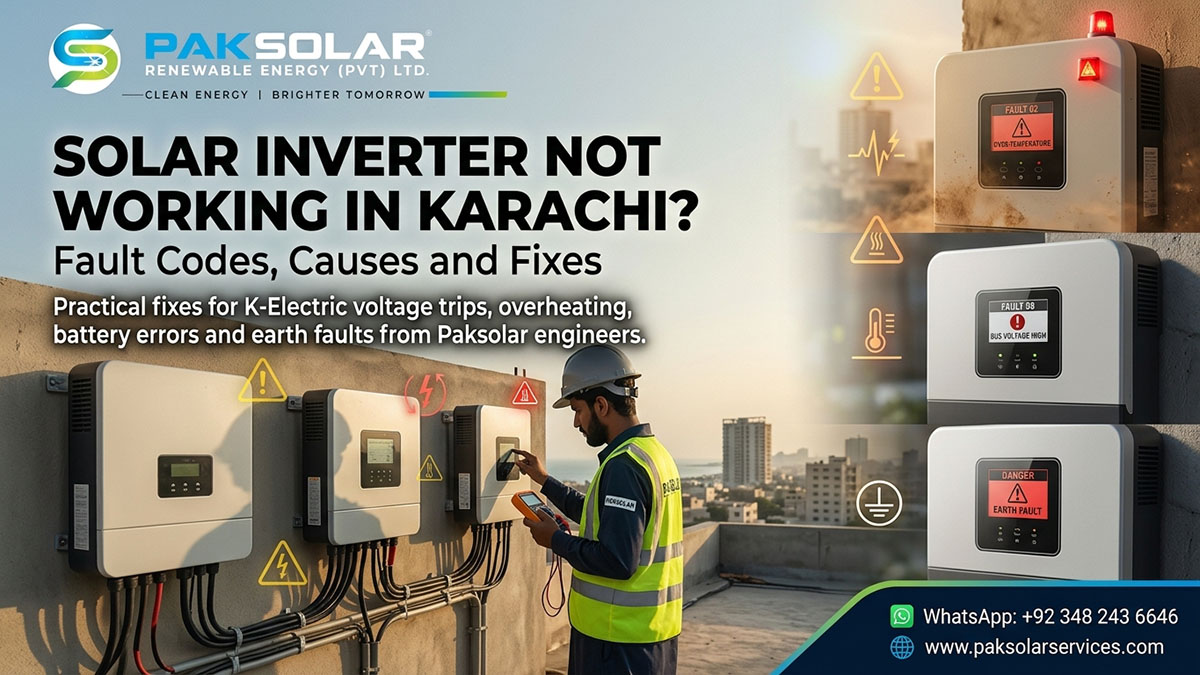
Solar Inverter Problems in Karachi: Fault Codes, Causes and Fixes
Quick answer: Most Karachi inverter faults come from five causes: grid voltage outside the inverter's window, heat and dust, wrong battery or BMS settings, earth/insulation leaks after rain, and missing zero-export setup. Read the fault code, check the grid voltage with a multimeter, and clean or ventilate the unit before anything else. Never open DC or battery wiring unless you are qualified.
If your solar inverter keeps tripping, shows an error code, or drops output in summer, you are not alone. Karachi homes face unstable feeder voltage, 40°C+ summers, coastal dust and salt, and monsoon humidity, and these conditions expose weak installations quickly. This guide explains the most common solar inverter problems in Karachi, what each error means, and what you can safely check yourself before calling an engineer.
Important: fault codes differ by brand, model and firmware. Treat the tables below as a starting point and always confirm with your inverter manual. Settings that change grid protection must be done by your installer.
1. Inverter Trips on K-Electric Grid Voltage
Karachi residents regularly report voltage swings and flickers on K-Electric feeders. Grid-tied and hybrid inverters disconnect when voltage leaves their allowed window (often around 253 V on the high side for a 230 V grid, though defaults vary by model and grid standard). Midday over-voltage is common when many neighbours export solar at the same time.
What to do
- Measure first: with a multimeter at the main AC board, note the voltage at midday and at night. Write down date and time.
- Check the breaker: a weak or undersized AC breaker is a frequent hidden cause of "tripping".
- Check cable size and tight terminals: long or thin AC cable raises voltage at the inverter during export.
- Off-grid/hybrid units: where the manual allows, the wider "appliance" input range tolerates more swing than the narrow "UPS" range.
- Do not raise protection limits yourself. Ask your installer; wrong limits can damage equipment and breach grid rules.
- Complain with evidence: share your voltage log with K-Electric (helpline 118) if readings stay outside normal.
Install a quality AC surge protector and a voltage protection relay. Load-shedding restoration spikes are a known cause of inverter board failure.
2. Overheating, Derating and Dust
Inverters reduce output (derate) or shut down when heatsinks and fans clog with Karachi's coastal dust. Units mounted in direct sun, closed cabinets or tiny store rooms run hotter and fail sooner.
- Mount in shade with the clearance the manual specifies (commonly 20-30 cm around the unit).
- Power the inverter fully off, then clean fan grills and fins with a dry brush or low-pressure air.
- Never place the inverter in a closed wooden box to "hide the wires".
- Schedule a cleaning check every 3-6 months in coastal areas.
3. Battery and BMS Communication Problems
Wrong battery type, wrong charge settings, or a missing BMS link cause incomplete charging, early battery ageing and frequent switching. Lithium batteries need the correct protocol selected on the inverter and the correct communication cable and address setting on the battery.
- Confirm the inverter lists your exact battery model as compatible.
- Select the lithium or matching protocol setting; do not leave a lead-acid profile on a lithium bank.
- Disable equalisation for lithium batteries.
- Use the cable pinout from the inverter and battery manuals; a standard LAN cable is not always correct.
- Set battery cut-off and recovery values from the battery datasheet, not from forums.
4. Earth Fault and PV Isolation Errors After Rain
Humidity and monsoon rain degrade MC4 seals, cable jackets and panel junction boxes, lowering insulation resistance and triggering "PV isolation" or "earth fault" messages. Salt air in Karachi speeds this up.
- Switch the system off and isolate AC, DC and battery before any inspection.
- Look for wet or cracked MC4 connectors, cables rubbing on metal rails and unearthed mounting frames.
- A qualified technician tests each string with an insulation resistance tester; a healthy string should read well above 1 MΩ.
- Replace damaged connectors and cables; do not just reset the error.
5. Zero Export and Net-Metering Delays
Systems waiting for a bi-directional meter should not push power to the grid. A zero-export CT or meter limits output to your load. The CT arrow direction and wiring differ by brand, so follow the inverter manual and confirm on the live screen that grid power never goes negative. For the new Prosumer framework, read our NEPRA Prosumer Regulations 2026 analysis and our net metering services page.
Common Fault Codes: Voltronic-Based Off-Grid and Hybrid Inverters
Many local off-grid and hybrid brands (for example Inverex, Knox, Fronus, MaxPower and similar) share this code family. Confirm against your own manual.
| Code | Meaning | First safe check |
|---|---|---|
| 01 | Fan locked | Clean dust, check fan rotation after power-off |
| 02 | Over-temperature | Improve shade and ventilation, clean heatsink |
| 03 | Battery voltage too high | Verify battery type and charge settings |
| 04 | Battery voltage too low | Recharge, check cables and connections |
| 05 | Output short circuit or over-temperature | Unplug loads, isolate the faulty circuit |
| 07 | Overload timeout | Reduce load, stagger pump and AC starts |
| 08 / 52 | Bus voltage too high / too low | Check string sizing; service if it repeats |
| 09 / 53 | Bus or inverter soft-start failure | Hardware fault, call a service centre |
| 51 | Over-current or surge | Check heavy motor loads and shorts |
| 58 | Output voltage too low | Check overload and battery condition |
Common Messages on Grid-Tied Brands
| Brand | Message | Usual cause and next step |
|---|---|---|
| Growatt | AC V Outrange | Grid outside limits or no grid. Measure AC voltage, check breakers |
| Growatt | PV Isolation Low / Residual I High | Moisture or damaged DC cable. Isolate and test insulation |
| Solis | OV-G-V / ISO-PRO | Grid over-voltage or insulation leak. Verify grid standard with installer |
| Solis | LimByEPM | Output limited by export control. Normal if zero export is active |
| GoodWe | Vac Failure / Utility Loss | Grid voltage or outage. Measure at AC isolator |
| GoodWe | Isolation Failure | Rain or humidity on DC side. Inspect connectors |
| Huawei | Low Insulation Resistance (2062) | DC cable or junction box leak to earth. Technician inspection |
Safe Restart Sequence
A clean power cycle clears many temporary lockups. Always follow your manual first.
Quick Triage Flow
Safety First
Inverters store charge in internal capacitors and solar strings carry high DC voltage that can arc. Switch off AC, DC and battery breakers and wait at least five minutes (or as the manual states) before opening anything. Do not disconnect MC4 connectors or communication cables under load. If you smell burning, see melted plastic or find a swollen battery, switch off safely and call a professional.
Need help in Karachi? Our team handles solar commissioning and re-commissioning, inverter supply and setup and battery integration. Send your fault code and photos via our query form, WhatsApp +92 348 243 6646 or contact us.
Frequently Asked Questions
Why does my solar inverter trip in the afternoon in Karachi?
Afternoon tripping is usually over-voltage on the feeder when many homes export solar together, or heat derating. Measure grid voltage at midday, check the AC breaker and cable size, and note the inverter temperature. If the voltage stays high, share your log with K-Electric and ask your installer to review the settings. A zero-export device limits what you send to the grid, but it does not fix a high grid voltage.
Can I change the grid voltage limits to stop trips?
Only through your installer. Limits protect your equipment and the grid, and net-metering approval can depend on the selected grid standard.
How do I stop my inverter shutting down or beeping on low grid voltage?
On many Voltronic-type off-grid and hybrid inverters, the AC input range can be set to a wider appliance mode instead of the narrower UPS mode. Check your manual for the exact program number and ranges, and ask your installer if you are unsure. Repeated sags below normal should also be reported to K-Electric.
Why is my battery backup dying so quickly during load shedding?
Common causes are an ageing or heat-damaged battery, deep discharge, a wrong battery type setting, and a lost communication link with a lithium battery, which makes the inverter guess the charge level. Check the cable and protocol settings, then have the battery capacity tested.
What does a PV isolation or earth fault error mean?
The inverter detected current leaking from the DC side to earth, often from moisture in MC4 connectors or damaged cables after rain. Switch off and have the strings tested with an insulation tester. Do not touch DC wiring yourself.
Why does my inverter show a battery communication error?
The protocol, battery address setting or communication cable is usually wrong or loose. Check the compatible battery list and the exact cabling in both manuals.
Why is my solar generation lower in winter?
Shorter days, a lower sun angle and winter haze reduce output, so lower winter yield is normal. Compare your daily kWh in the monitoring app with the same period last year, and call us if output is much lower than before.
Why does my inverter overheat in the afternoon?
Direct sun, poor ventilation and dusty heatsinks are the main causes. Move or shade the unit, keep the manual's clearances and have it cleaned regularly.
Is it safe to reset an inverter myself?
A normal power cycle following the manual is safe. Opening the inverter or touching DC wiring is not; leave that to a qualified technician.


